
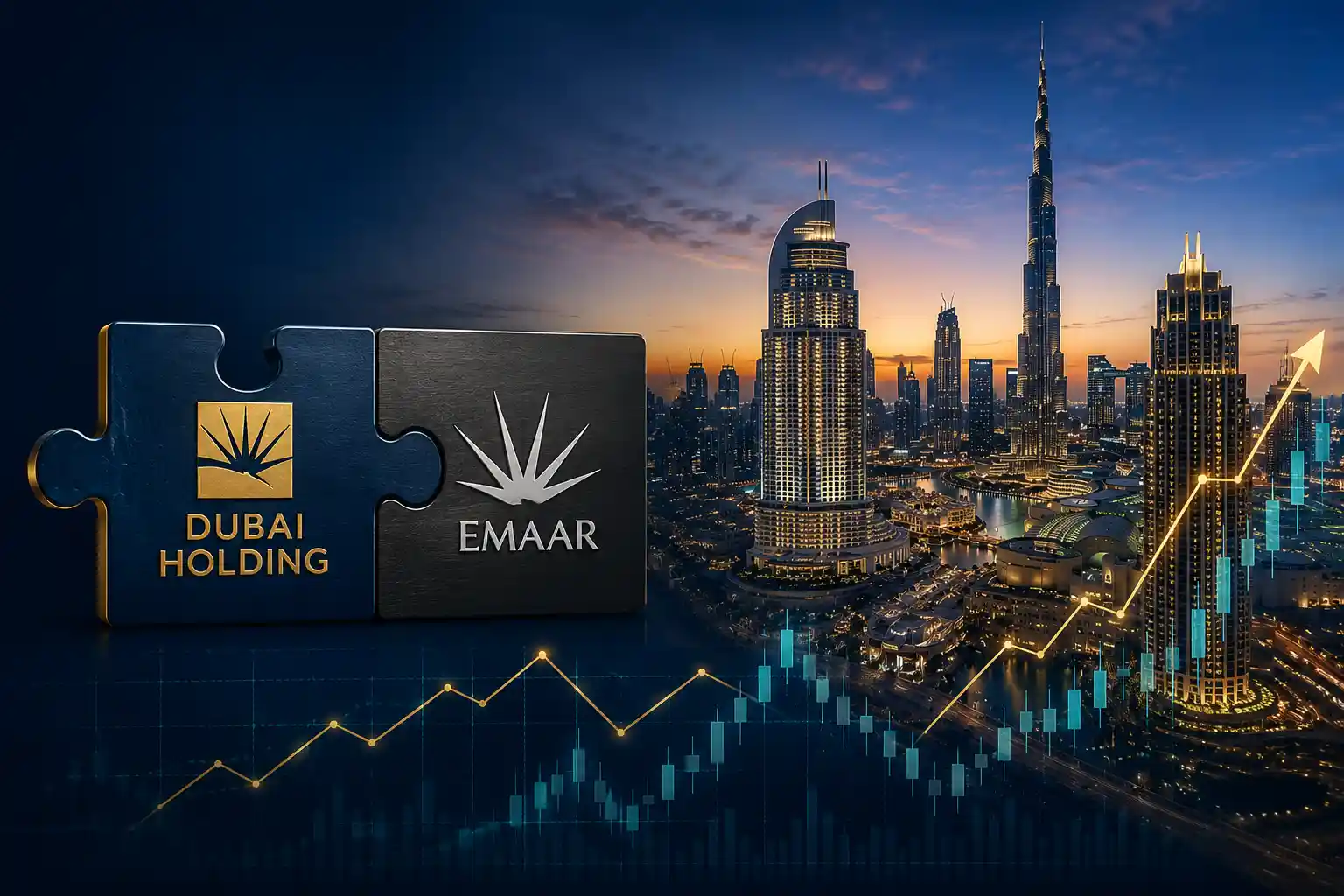
Dubai Holding Buys Emaar Stake: What It Means for Investors
What Does the Dubai Holding–Emaar Acquisition Actually Mean? The Deal Behind the Headlines and Why Investors Should Be Paying Attention
The Dubai Holding–Emaar acquisition is the single largest institutional real estate move in Dubai in recent memory. The Investment Corporation of Dubai transferred its entire 22.27% stake in Emaar Properties to Emirates Power Investment — a wholly owned subsidiary of Dubai Holding — pushing Dubai Holding's total shareholding from 7.46% to 29.73% and making it the biggest single shareholder in Emaar. The transaction is valued at approximately AED 23.9 billion based on DFM trading valuations. For anyone who owns, or is planning to buy, Emaar property, this matters.
The Deal Structure: Equity Transfer, Not a Merger
Before you read anything else, understand what this deal is not. This is not a corporate merger, a hostile takeover, or the end of Emaar as an independent business. Emaar Properties remains publicly listed on the Dubai Financial Market, managed by its own board, operating under its own brand. The handovers, quality standards, and the Emaar name stay exactly as they are. What changed is who sits at the top of the ownership table.
Dubai Holding already controls Nakheel, Meraas, and Dubai Properties — three of the largest master-developers in the emirate. Adding a 29.73% stake in Emaar to that portfolio creates something that did not exist before: a single institutional umbrella covering virtually every major master-planned community in Dubai. Jumeirah Group, the hospitality arm, sits inside that same umbrella. I have spoken to clients who are asking whether their Emaar unit is at risk — it is not. What is changing is the strategic coordination at the top, not the product they are buying.
The corporate relationship between Emaar and Dubai Holding is not new. In 2022, Emaar bought out Dubai Holding's stake in the Dubai Creek Harbour development for AED 7.5 billion — part cash, part Emaar shares. This 2026 transaction is the logical endpoint of that alignment, not a sudden pivot.
Emaar's Financial Position at the Time of the Deal
The acquisition did not happen in a vacuum. Emaar's Q1 2026 financial results came out alongside the announcement, and the numbers confirm the developer is operating at its highest performance level on record.
Net profit for Q1 2026 rose to AED 6.4 billion — a 33% year-on-year increase. Revenue for the quarter reached AED 12.4 billion, up 23% year-on-year. Property sales hit AED 22.4 billion, driven by strong demand and a series of successful off-plan launches. The revenue backlog — the contracted sales not yet recognised as revenue because the properties are still under construction — now stands at AED 163.4 billion. That backlog alone represents years of guaranteed forward revenue. Emaar's global land bank covers 600 million square feet, with 317 million square feet inside the UAE.
When Dubai Holding paid approximately AED 23.9 billion to acquire the ICD stake, it was buying into a business firing at full capacity. That is not coincidence — it is confirmation that the state-level investors view the current window as the right entry point, even at peak valuations.
What This Means for Off-Plan Buyers and Investors in Emaar Projects
Counterparty Risk Drops Further
One concern that experienced investors always factor in when buying off-plan is developer risk — the possibility that the developer cannot deliver. With Dubai Holding's institutional weight now behind Emaar, that concern becomes even less relevant than it already was. Industry analysis shows that Emaar properties command a 15% to 20% premium in secondary resale values over comparable units from smaller private developers. That premium exists because buyers trust delivery. This deal reinforces the foundation behind that trust.
The Ecosystem Advantage
Based on my experience working on projects across MBR City and the wider Dubai market, I have seen first-hand how the alignment of master-developers affects the buyer experience. When Nakheel, Meraas, and Emaar operate independently, there are gaps — in retail integration, waterfront access, community infrastructure. Bringing them under a common ownership structure means future Emaar residential projects can more cleanly integrate Meraas-style retail, Nakheel-engineered waterfront, or Jumeirah-managed hospitality. That is not a feature that exists today, but it is the direction this deal is pointing.
For buyers looking at projects in Emaar South, Dubai Creek Harbour, or The Oasis, the long-term community development trajectory now benefits from coordinated planning rather than competing priorities between state-backed entities.
The Bigger Picture: Dubai 2040 and Market Confidence
Dubai recorded AED 252 billion in real estate transactions in Q1 2026 alone — a 31% year-on-year increase according to DLD data. That headline number tells you something important: the market was already running at full pace before this institutional move. What the Dubai Holding–Emaar deal does is provide long-term structural confidence that sits above the cycle.
The Dubai 2040 Urban Master Plan requires the kind of coordinated infrastructure delivery that is very difficult when major developers are competing for the same land and investor capital. With Dubai Holding now aligned with Emaar in addition to Nakheel, Meraas, and Dubai Properties, the execution pathway for 2040-linked projects — from transport corridors to urban density targets — becomes significantly more coherent. Analysts and brokers on the ground are describing this as the structural backbone needed to actually deliver what the 2040 plan promises.
I have watched this market through multiple cycles since 2013 — from the post-Arab Spring correction through COVID-19 recovery to where we are now. What I have not seen before is this level of institutional alignment at the top of the developer stack. This is not routine market movement. It is a structural shift that will compound over years, not months.
Key Emaar Projects to Watch in 2026 and Beyond
Three Emaar development corridors are drawing the most attention from serious investors following this deal:
- Emaar South — positioned directly adjacent to Al Maktoum International Airport. The airport expansion project is one of the largest infrastructure commitments in the region. Proximity to that expansion makes Emaar South a medium-to-long-term play with solid capital growth potential.
- The Oasis by Emaar — a USD 20 billion ultra-luxury mansion and villa community targeting ultra-high-net-worth buyers. This project sits at the far premium end of the Emaar portfolio and is not entry-level. It is worth tracking for the direction it signals about where Emaar sees the ceiling on Dubai pricing.
- Dubai Creek Harbour — the site where the future Creek Tower is planned. Designs are progressing. Given the history between Emaar and Dubai Holding at Creek Harbour specifically, this location sits at the centre of the institutional relationship and is likely to benefit from coordinated planning moving forward.
Frequently Asked Questions
1. What exactly did Dubai Holding acquire in the Emaar deal?
Dubai Holding acquired a 22.27% equity stake in Emaar Properties that was previously held by the Investment Corporation of Dubai (ICD). The stake transferred to Emirates Power Investment, a wholly owned Dubai Holding subsidiary. This pushed Dubai Holding's total Emaar shareholding from approximately 7.46% to 29.73%, making it the single largest shareholder in the company.
2. How much is the Dubai Holding–Emaar stake worth?
Based on DFM trading valuations at the time of the transfer, analysts value the 22.27% stake at approximately AED 23.9 billion — equivalent to around USD 6.5 billion. This is an equity market valuation, not a transacted sale price in the traditional sense.
3. Will Emaar's branding, management, or handover process change?
No. Emaar Properties remains an independently managed, publicly listed company on the Dubai Financial Market. Its board, brand, operational standards, and project delivery processes are unaffected by the ownership transfer. The change is structural at the shareholder level, not operational.
4. Is investing in Emaar off-plan properties safer now?
Emaar off-plan has always carried lower counterparty risk than most private developers, because of the developer's track record, escrow account compliance, and RERA oversight. Dubai Holding's increased stake adds another layer of institutional backing. For buyers who were already comfortable with Emaar's delivery history, the risk profile is now incrementally stronger — not transformed overnight, but reinforced.
5. Does this deal affect the Dubai real estate market news for 2026?
Yes, and on multiple levels. It signals confidence at the highest institutional level — an AED 23.9 billion commitment from a government-linked entity that manages over AED 500 billion in global assets. It strengthens the alignment between major developers under the Dubai 2040 Urban Master Plan. And it adds weight to Dubai's narrative as a safe destination for international capital at a time when global investors are watching closely.
6. How does the Nakheel, Meraas, and Emaar consolidation affect buyers?
In practical terms, the immediate impact on individual buyers is indirect. The consolidation reduces the likelihood of major master-developers competing for the same plots or cannibalising each other's investor base. Over the medium term, it creates conditions for better-integrated communities — where residential, retail, waterfront, and hospitality offerings are planned cohesively rather than independently.
7. Which Emaar projects make the most sense to buy in 2026?
That depends on your investment timeline and risk appetite. Emaar South suits investors with a 5-to-10-year horizon who want proximity to the Al Maktoum Airport expansion. Dubai Creek Harbour offers strong infrastructure credentials and is a mid-range entry point into the Emaar portfolio. The Oasis targets a very specific ultra-high-net-worth buyer profile. I would not give a blanket answer — the right project depends on your exit strategy, holding period, and capital position.
If the Dubai Holding–Emaar deal has raised questions about where your capital sits best in this market — which project, which payment structure, which timeline — that is exactly the kind of conversation worth having with someone who works these projects daily. To discuss your investment position in light of this deal, contact Saliq Zahoor directly. WhatsApp +971 567 123 666 or email [email protected]. Visit www.eplogproperties.com for current listings and market data.
For weekly Dubai real estate analysis and on-the-ground market updates, follow @saliqzahoordxb on Instagram, TikTok, YouTube, and LinkedIn.