
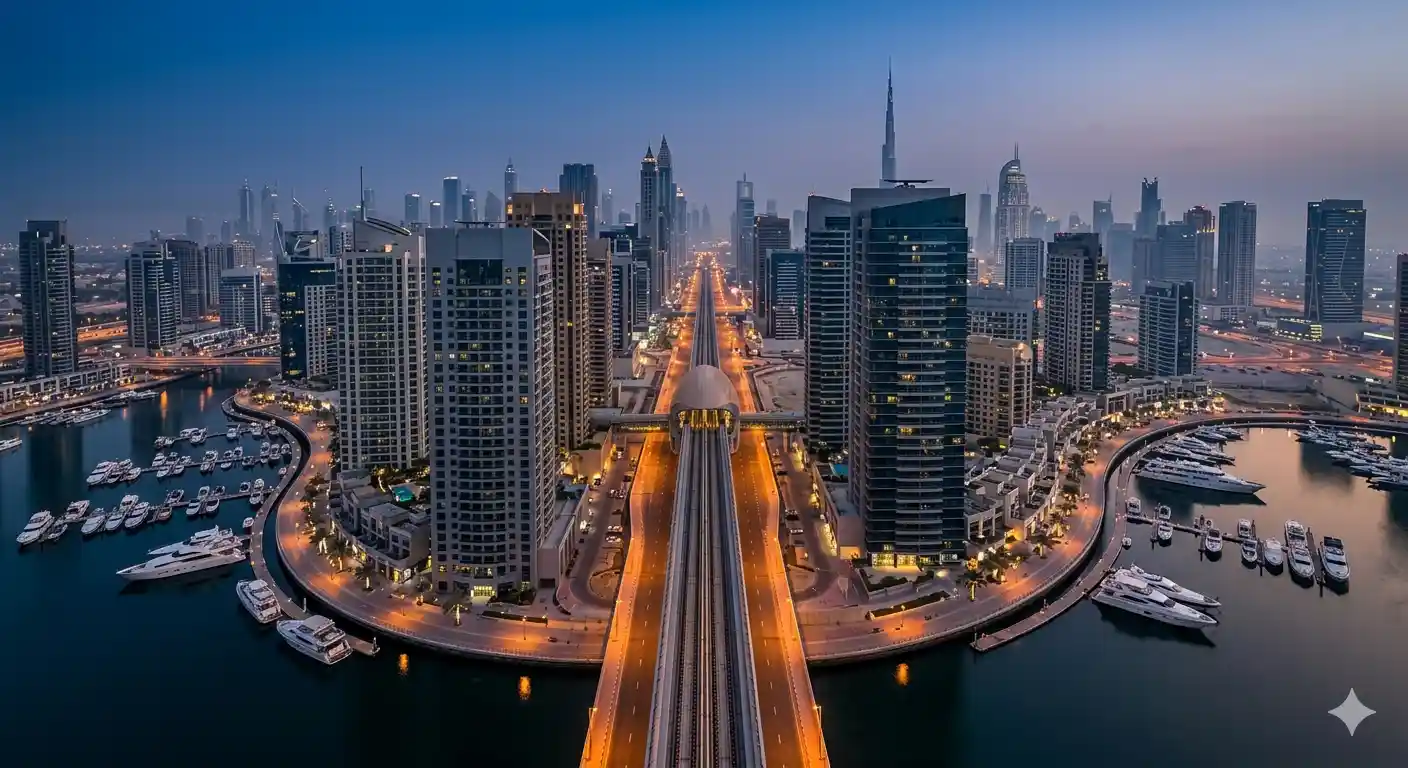
Dubai Metro Blue Line Investment Map 2026 | Properties to Buy Now
Is the Dubai Metro Blue Line the Biggest Property Opportunity of 2026? What Investors Need to Know Before the Surge
The Dubai Metro Blue Line is a 30-kilometre, AED 18 billion transit corridor scheduled for completion in 2029 and the most significant infrastructure-driven property opportunity currently open in Dubai. History in this city is consistent: properties within 800 metres of a metro station outperform the market on capital appreciation, and the window to buy before that premium is fully reflected in asking prices is closing.
Why Infrastructure Moves Dubai Property Prices More Than Any Other Factor
Dubai property investors often focus on developer brand, project design, or location prestige. All of those matter. But over a 10-year hold horizon, infrastructure connectivity has repeatedly demonstrated a larger and more reliable impact on capital growth than any of those factors.
Analysis of transit-oriented developments along Dubai's existing Red and Green Lines shows properties within 800 metres of metro stations have appreciated by up to 26.7% annually in peak periods and delivered capital growth of 10% to 25% by the time a line reached full operational status. The mechanism is simple: transit access expands a property's practical tenant pool, reduces reliance on car ownership, and draws the end-user demographics families, professionals, young couples that create sustained rental demand.
The Blue Line replicates that dynamic across communities that are currently priced as peripheral. For an investor buying in 2026, the play is straightforward: acquire in an underpriced corridor today, hold through the construction phase, and exit or refinance after station delivery in 2029.
The Metro Blue Line: Route, Scale, and Connection Points
The Blue Line runs 30 kilometres across Dubai's northern and eastern zones, connecting to the existing Red and Green Lines at interchange stations. Of the 14 stations planned, 15.5 kilometres run underground and 14.5 kilometres are elevated. The line is being built to mark the 20th anniversary of the Dubai Metro in 2029 and represents the largest single expansion of the network since the original Red Line launched.
The key communities served include Dubai Creek Harbour, Dubai Silicon Oasis, Academic City, International City, and Dubai Festival City. Each of these corridors has a distinct buyer profile and growth outlook and each is currently priced at a discount to where comparable communities sit once metro access is established.
Station-by-Station Investment Analysis
Dubai Creek Harbour
Creek Harbour is already a premium master plan Emaar's flagship waterfront community with high-rise towers, retail, and marina infrastructure. The Blue Line adds transit connectivity to an area that currently relies entirely on road access. Price-per-square-foot in the off-plan segment runs approximately AED 2,100 to AED 2,250 as of Q1 2026. The projected capital appreciation on station delivery sits in the 20% to 25% range for well-located units. This is the highest-entry and highest-upside corridor on the line.
Dubai Silicon Oasis
Silicon Oasis is an established mid-market community serving a tech and professional demographic. Current price-per-square-foot in the ready segment sits at approximately AED 1,054. The Blue Line changes the community's connectivity profile significantly it becomes a transit-linked mid-market option at a price point well below the Downtown-adjacent alternatives. Rental yields here are expected to compress upward as tenant demand from commuting professionals increases after 2029.
Academic City
Academic City is an emerging corridor built around a cluster of international universities and research institutions. Price-per-square-foot currently ranges from approximately AED 1,100 to AED 1,200 in the off-plan segment. The investment case is anchored in a structurally reliable tenant pool students, faculty, research staff that creates low-vacancy, consistent yield rather than speculative capital appreciation. Off-plan projects here offer flexible payment plans and lower entry points than most Blue Line corridors.
International City
International City is Dubai's most yield-driven mid-market community. Current price-per-square-foot runs approximately AED 750 to AED 850 the most affordable entry point on the Blue Line route. Gross rental yields citywide hit 8% to 11% in this community, the highest in Dubai. The Blue Line's arrival is expected to ease the yield compression that typically affects high-occupancy affordable communities by drawing additional tenant demand and reducing the premium that central locations currently command on accessibility grounds.
Dubai Festival City
Festival City is an established premium community combining retail, entertainment, and corporate facilities. Current pricing in the ready segment runs approximately AED 1,500 to AED 1,750 per square foot. For investors, this is a hold-and-yield play rather than a high-growth story — the community is mature and the transit premium adds stability rather than dramatic appreciation. Corporate and family tenants provide consistent occupancy.
Investment Comparison: Blue Line Corridors at a Glance
Community | Price/sqft (Q1 2026) | Projected Upside | Best-Fit Buyer |
Dubai Creek Harbour | AED 2,100 – 2,250 | 20% – 25% | High-net-worth, capital growth focus |
Silicon Oasis | AED 1,054 | Strong yield growth | Mid-market, rental yield investor |
Academic City | AED 1,100 – 1,200 | Stable yield | Institutional, student accommodation |
International City | AED 750 – 850 | High yield, 8–11% | Entry-level, yield-first investor |
Festival City | AED 1,500 – 1,750 | Stability + modest growth | Family and corporate tenant profile |
The Pre-Surge Window: Why 2026 to 2028 Is the Critical Period
The investment logic for infrastructure-adjacent property follows a consistent pattern in Dubai. In the announcement phase, prices reflect uncertainty. In the construction phase, prices begin to move but remain below their eventual post-delivery level. Once a station opens and the connectivity benefit is live — visible, measurable, and accessible to tenants — the premium is fully embedded in asking prices and secondary market valuations.
The Blue Line is currently in construction. The 2026 to 2028 buying window is the period when entry prices have moved from the announcement baseline but have not yet reached the delivery premium. For investors who missed the original Red Line appreciation cycle, this corridor presents a comparable structural opportunity at a more measured pace.
Alignment with the Dubai 2040 Urban Master Plan adds a long-term policy tailwind. The plan targets 55% of Dubai's population living within 800 metres of mass transit by 2040. The Blue Line communities are exactly the infrastructure expansion that delivers that target — which means continued government investment in the surrounding areas is a structural expectation, not a speculative assumption.
Risks to Understand Before Committing Capital
Infrastructure-adjacent investment carries specific risks. Construction delays on large-scale transit projects are not uncommon, and the 2029 target is subject to change — though the RTA has a strong completion track record on previous metro phases. A delay shifts the appreciation timeline but does not negate the long-term case.
Oversupply in specific corridors is a more immediate risk. Silicon Oasis and International City have large volumes of similar stock. Buyers should select projects with distinct layouts, developer credibility, and proximity to the confirmed station location rather than buying generic inventory in the general area. The 800-metre radius matters: a property 1.2 kilometres from a station does not capture the same transit premium as one at 400 metres.
Frequently Asked Questions
1. When will the Dubai Metro Blue Line open?
The Blue Line is scheduled for completion in 2029 to mark the 20th anniversary of the Dubai Metro. The project is under active construction and the RTA has not announced delays as of mid-2026, though large infrastructure programmes are always subject to timeline revision.
2. How much has property appreciated near existing Dubai metro stations?
Analysis of transit-oriented developments along the Red and Green Lines shows properties within 800 metres have appreciated by up to 26.7% annually in peak appreciation periods, with average capital growth of 10% to 25% between line announcement and full delivery. Individual project performance varies significantly based on developer, location quality, and market conditions at entry.
3. Which Blue Line community offers the best rental yield?
International City currently offers the highest gross rental yields on the Blue Line corridor — approximately 8% to 11% as of Q1 2026. Silicon Oasis and Academic City also offer strong yields in the 8.5% to 9% range. Creek Harbour and Festival City offer lower yields but stronger capital appreciation profiles.
4. Is it better to buy ready or off-plan near the Blue Line?
Off-plan purchases in 2026 to 2027 offer the best entry pricing and often come with developer payment plans that reduce upfront capital requirements. Ready property provides immediate rental income but at a higher entry cost. For investors whose primary target is capital growth on station delivery, off-plan with staged payments is generally the more efficient structure in this cycle.
5. Does the 800-metre radius really matter for transit premiums?
Yes — and the data is consistent on this. Properties beyond 800 metres from a station do not capture the same accessibility premium as those within walking distance. At 1.2 kilometres to 1.5 kilometres, the transit benefit becomes marginal. When evaluating any property near the Blue Line route, confirm the actual walking distance to the confirmed station location, not the community name's proximity on a map.
6. Are there Golden Visa benefits available for Blue Line corridor properties?
Properties priced at AED 2 million or above qualify for the 10-year Golden Visa regardless of location. Several off-plan projects in Dubai Creek Harbour are priced at or above this threshold. For properties priced below AED 2 million, the two-year investor visa applies — and for sole ownership, the AED 750,000 minimum has been removed as of 2026.
7. What should I avoid when buying near the Blue Line?
Avoid buying in the general area of a future station without confirming the exact station position and walking distance. Avoid large high-density projects in communities with existing oversupply — particularly in Silicon Oasis and International City — unless the specific building has differentiated features. Do not rely on a developer's marketing material alone for capital growth projections; cross-reference against independent DLD transaction data.
If you are looking at the Blue Line corridor and want a clear-eyed view of which projects are genuinely positioned for transit-led growth versus which are riding the marketing wave, speak to someone who analyses these transactions daily. Call or WhatsApp +971 567 123 666 for a straightforward conversation about your entry options.