
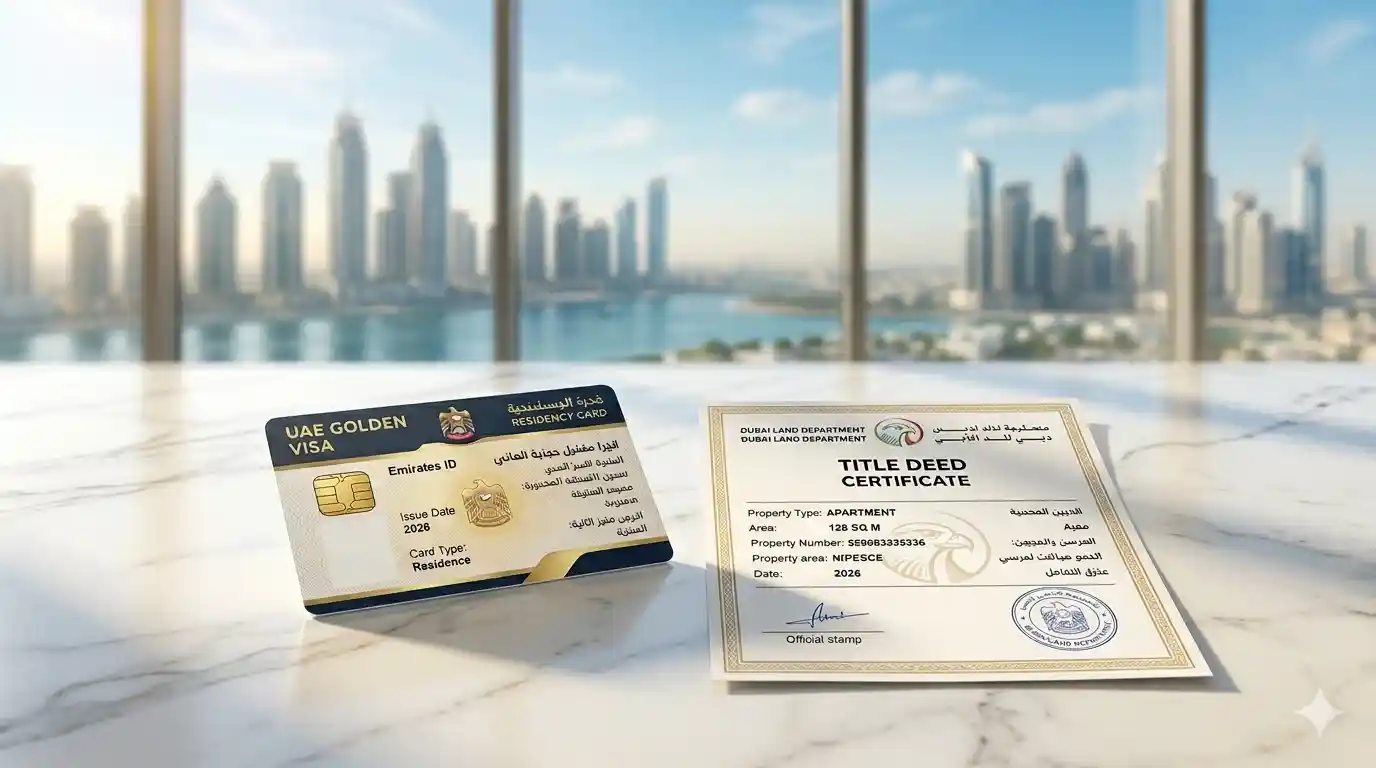
Dubai Property Golden Visa 2026 | 2-Year & 10-Year Residency Guide
How Do You Get Residency Through Property in Dubai? The 2026 Golden Visa and Investor Visa Rules Explained
Owning property in Dubai qualifies you for residency — and the rules governing that qualification changed meaningfully in 2026. The Dubai Land Department and ICP now offer three distinct property-linked residency categories, each with different investment thresholds, mortgage rules, and long-term benefits. If you are buying property in Dubai partly because of the residency option, understanding exactly which category you qualify for — and what restrictions apply — should happen before you sign, not after.
The Three Property-Linked Residency Visas Available in 2026
1. 2-Year Investor Visa
Minimum Investment: No minimum for sole owners, or AED 400,000 for joint ownership.
Key Conditions: Applicable in freehold zones only. Mortgages are permitted with 50% equity. The previous AED 750,000 limits are removed for sole owners.
Core Benefits: Renewable residency; requires UAE entry at least once every 6 months.
2. 5-Year Retirement Visa
Minimum Investment: AED 1 million in property or savings.
Key Conditions: Applicant must be aged 55 or older. Alternatively, a fixed annual income of AED 240,000 also qualifies.
Core Benefits: Five-year renewable residency tailored for long-term retirees.
3. 10-Year Golden Visa
Minimum Investment: AED 2 million (can be a single property or multiple properties).
Key Conditions: Mortgaged property requires bank approval and a 20% down payment. For off-plan properties, construction must be 50%+ complete.
Core Benefits: Self-sponsored residency with no minimum stay requirement. Allows you to sponsor your family and up to 3 domestic staff members.
The 2-Year Investor Visa: What Changed and Who It Affects
The most significant update to Dubai's property residency framework in 2026 is the removal of the AED 750,000 minimum for sole ownership of the two-year investor visa. Previously, sole ownership below that threshold did not qualify — which excluded a substantial segment of Dubai's residential buyer market. That restriction has been lifted.
For sole owners, there is now no stated minimum property value. You own a freehold residential property in Dubai in your name alone and you are eligible to apply for the two-year renewable investor visa. For joint ownership — where two or more parties share ownership of a single property — the AED 400,000 minimum per person's equity share applies.
Mortgage-financed properties are permitted, but the equity position matters. You need at least 50% of the property value as paid equity — meaning if you purchased at AED 1.5 million on a mortgage, you need at least AED 750,000 of that paid down before the visa application qualifies. The outstanding mortgage cannot exceed 50% of the property's value.
The 6-Month Re-Entry Requirement
The two-year visa requires you to enter the UAE at least once every six months to keep it active. This is a residency card, not a long-term settlement document — it does not grant the freedom to be absent for extended periods without renewal risk. For buyers who plan to use Dubai property as an investment while based elsewhere, the 10-year Golden Visa is the more appropriate structure.
The 10-Year Golden Visa: The AED 2 Million Threshold in Detail
What Counts Toward the AED 2 Million Threshold
The 10-year Golden Visa requires a minimum property investment of AED 2 million. This can be achieved across multiple properties — you do not need a single unit at that price point. A combination of a residential apartment and a studio, or two separate units in different developments, can aggregate to meet the threshold provided the combined assessed value reaches AED 2 million and all units are in freehold zones.
Mortgaged Properties and the 20% Rule
For mortgaged properties counting toward the Golden Visa, the bank holding the mortgage must provide a letter confirming the property's status, and a minimum 20% down payment must have been made — meaning the outstanding mortgage cannot represent more than 80% of the purchase price. Properties where the mortgage is still above 80% loan-to-value do not qualify until sufficient equity is built.
Off-Plan Properties: The 50% Completion Rule
Off-plan properties can count toward the Golden Visa threshold, but only once the project is at least 50% complete. A property purchased at launch with 10% paid does not qualify immediately — it qualifies once the DLD confirms the project has reached the 50% construction milestone. For buyers purchasing in MBR City, District One West, or any of Dubai's major master-planned communities off-plan, factor this timeline into your visa planning.
What the Golden Visa Actually Gives You
The 10-year Golden Visa is self-sponsored — you do not need an employer or a UAE sponsor to hold it. There is no minimum stay requirement, meaning you can live outside the UAE for extended periods without the visa lapsing, unlike the six-month rule that applies to the two-year visa. You can sponsor your spouse, children of any age, and up to three domestic staff members. The visa is renewable every ten years as long as the qualifying property investment is maintained.
The 5-Year Retirement Visa: The Option Most Buyers Overlook
The retirement visa is available to applicants aged 55 or older who either own property worth AED 1 million, hold AED 1 million in savings within a UAE bank, or receive a fixed annual income of AED 240,000 or more. It is renewable every five years and specifically designed for those relocating to Dubai permanently after their working career.
For investors in this age bracket who are planning to use Dubai as a base in retirement rather than as a pure investment vehicle, this option is often simpler to qualify for than the Golden Visa — particularly if the property portfolio sits between AED 1 million and AED 2 million in total value.
How Residency Policy Is Reshaping Dubai's Buyer Profile
The expansion of property-linked residency options — particularly the removal of the AED 750,000 sole ownership threshold — is having a measurable effect on who is buying Dubai property. In Q1 2026, female investors accounted for 15,540 transactions valued at AED 32 billion, continuing a sustained trend that saw female-led transactions reach AED 154 billion across 2025 as a whole.
The broader pattern is a shift from transient investment buying toward permanent settlement purchasing. Buyers are choosing larger units — three and four-bedroom apartments, villas, and townhouses — rather than the compact studios and one-bedrooms that dominate pure investment portfolios. Dubai's long-term population base is expanding, and the residency framework is one of the primary drivers.
For areas like MBR City and District One, where the housing stock leans toward family-sized units and lifestyle-integrated communities, this demographic shift directly supports long-term tenant demand and owner-occupier stability.
The Application Process: What You Need and What It Costs
The application for all three property-linked visas goes through the ICP (Federal Authority for Identity, Citizenship, Customs & Ports Security) and is initiated after the DLD confirms the qualifying property purchase. Required documentation typically includes:
Government fees for the residency application run approximately AED 3,000 to AED 4,500 depending on visa type and processing route. Processing typically takes three to ten working days through the standard online ICP portal, or faster through typing centres and registered PRO services. Costs for the Emirates ID, medical test, and visa stamping add approximately AED 1,000 to AED 2,000 in total ancillary fees.
Frequently Asked Questions
1. Does buying any property in Dubai qualify me for a visa?
Only freehold property in designated freehold zones qualifies for property-linked residency. Leasehold property does not. Properties in non-freehold areas — typically older parts of the city or certain villa communities — do not generate visa eligibility. Always confirm freehold status with the developer or the DLD before purchasing with residency as a primary objective.
2. Can I use an off-plan property to qualify for the Golden Visa immediately after purchase?
No. Off-plan properties qualify for the 10-year Golden Visa only once the project reaches 50% construction completion, as confirmed by the DLD. You can purchase now and begin the visa application once that milestone is reached — but do not expect immediate eligibility on a newly launched project.
3. What happens to my visa if I sell the qualifying property?
Your property-linked residency is tied to the qualifying investment. If you sell without replacing the qualifying property, your visa application becomes invalid and the existing visa is cancelled. You have a grace period — typically 60 days — to either secure a replacement property or transfer to another residency category. Do not sell a qualifying property without a clear plan for maintaining residency status.
4. Can a couple buy a single property jointly and both get Golden Visas?
For the 10-year Golden Visa, each applicant needs AED 2 million in qualifying property investment. A joint purchase where each person's equity share is AED 1 million does not meet that threshold for either individual. A couple would need either a combined portfolio of AED 4 million split equally, or one partner meeting the full AED 2 million threshold on their share.
5. Does the property need to generate rental income for the visa to remain valid?
No. The visa is based on the ownership and value of the property, not on whether it produces income. An owner-occupied property qualifies on the same basis as a tenanted investment property, provided the ownership and value conditions are maintained.
6. Can I sponsor my parents on a property-linked residency visa?
The 10-year Golden Visa allows sponsorship of children of any age but does not automatically include parents. Sponsoring parents requires a separate dependent visa application and is governed by the ICP's standard family sponsorship rules, which depend on the sponsor's income and housing capacity rather than the property value.
7. Is it worth buying property specifically for the Golden Visa if I do not plan to live in Dubai?
That depends entirely on the property's investment case independent of the visa. A property that generates 7% to 8% net yield in a high-demand Dubai community is a sound investment regardless of the visa benefit. Buying a poorly performing property solely for a visa you will rarely use is not a coherent financial decision. Evaluate the property first. If the visa is an additional benefit on a strong asset, that is the right structure.
If you are planning a Dubai property purchase and the residency angle is part of your decision, speak to an agent who handles these transactions daily — not one who will oversimplify the eligibility rules to close a deal. Call or WhatsApp +971 567 123 666 for clarity on which visa category your purchase qualifies for and which communities align with your budget and residency goals.