
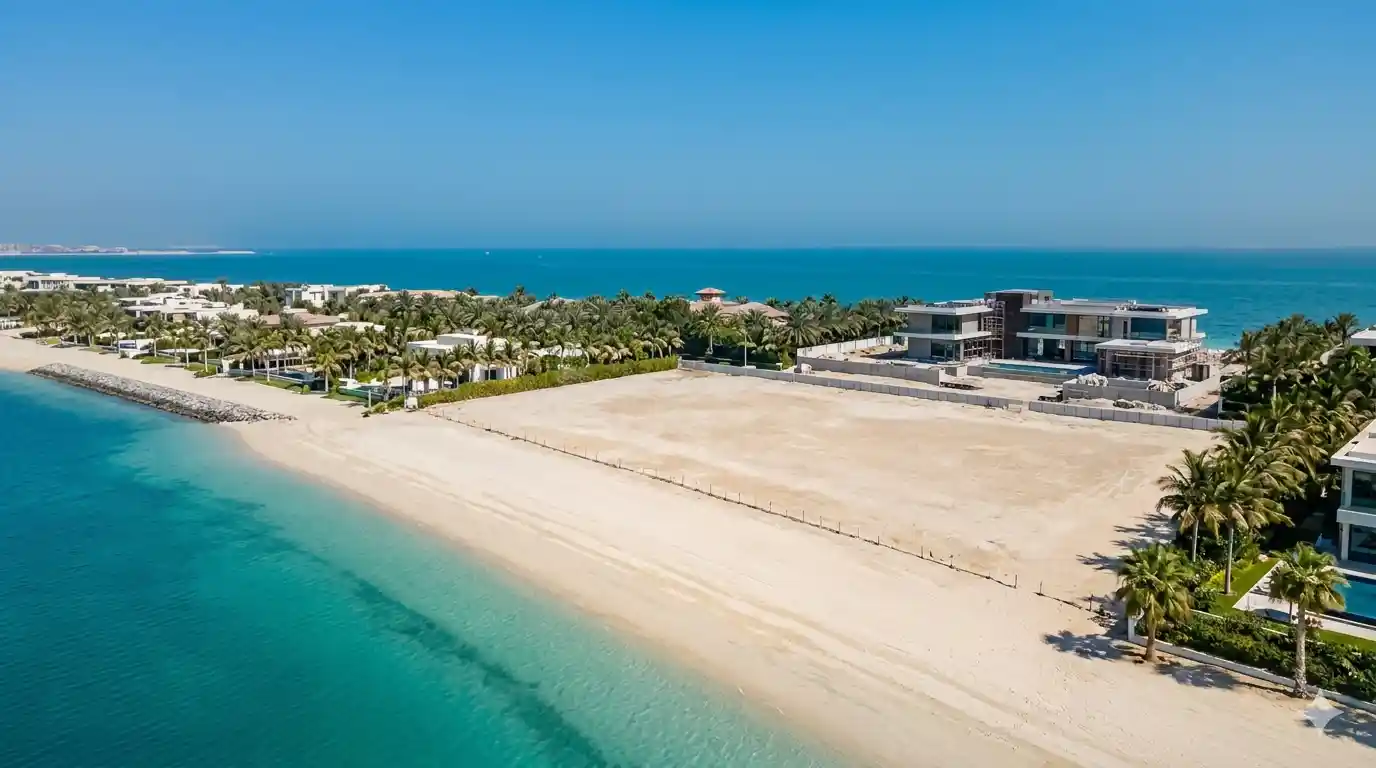
Dubai's AED 560M Beachfront Sale: What Naïa Island Signals
Is Dubai Now the World's Most Compelling Beachfront Market? What a AED 560 Million Land Deal on Naïa Island Actually Tells Us
A single beachfront estate on Naïa Island just sold for AED 560 million — the largest land acquisition of its kind ever recorded in the UAE. The plot exceeds 80,000 sq ft. The buyer is a European national. The deal was conducted entirely off-market. And it was not a completed mansion — it was land. That distinction matters more than the headline number.
What Was Actually Sold — and Why the Land Price Is the Story
When most people hear about a record-breaking Dubai property deal, they picture a finished penthouse or a turnkey villa. This transaction is something else entirely. The AED 560 million was paid for a coastal landholding — the right to build one private estate at a scale that, until this point, has not been commercially available anywhere in the UAE.
To put the size in context: beachfront plots on Jumeirah Bay Island — one of Dubai's most established luxury island addresses — range from approximately 14,000 to 25,000 sq ft, with only a handful reaching 37,000 sq ft. The previous benchmark on Naïa Island itself, a 53,000 sq ft beachfront plot that sold for AED 377 million in May 2026, was already considered extraordinary. The estate at the centre of this new transaction is, by initial measurements, roughly 1.5 times that size — possibly more once final confirmation is issued. This is not an incremental record. It is a category that did not exist before.
I have worked in this market since 2013, across construction and brokerage, and I have watched Dubai redefine what is possible at the top end of real estate multiple times. This transaction is different. It is not a developer pushing a new project. It is a private buyer, with the capital and the patience, choosing Dubai's coastline over every other coastal market available to them globally.
Naïa Island: Why This Address Is Not Comparable to Anything Else in Dubai
Naïa Island sits off the Jumeirah coastline between Umm Suqeim and Jumeirah 3, developed by Shamal Holding as a deliberately low-density, low-rise private island. Fewer than 100 beachfront plots were planned for the entire island from the outset. Since the island's launch in late 2025, approximately 65 of those plots have already changed hands, according to DLD data compiled by Cushman & Wakefield Core. The remaining inventory is fixed — there is no mechanism to create additional coastal land on a private island of set geography.
The island's hospitality anchor is the region's first Cheval Blanc Maison, an LVMH-linked French luxury brand. That is not a minor detail. In Dubai's prime areas, properties tied to globally recognised hospitality brands have commanded premiums of up to 98% over comparable non-branded product. The Cheval Blanc presence defines the ownership environment — buyers are not acquiring a plot beside a generic building, but within a curated coastal estate with managed service standards and a brand that protects the quality of the entire address.
Since its launch, Naïa Island has accounted for approximately 40% of Dubai's ultra-prime seaside residential and plot transactions above AED 150 million, based on 27 Naïa deals out of 70 recorded seaside transactions between January 2025 and April 2026, according to REIDIN data. Transactions worth approximately AED 1.5 billion were recorded across March and April 2026 alone.
Who Is Buying — and What Their Motivation Tells Us
Buyer demand on Naïa Island reflects a genuinely global capital base. European buyers, including those from the UK, account for approximately 45% of transactions. Asian buyers represent around 20%, Middle Eastern buyers including GCC nationals account for roughly 18%, North American buyers around 10%, and Oceania at approximately 2%. Every transaction has been conducted off-market — not publicly advertised or listed on any platform.
That buyer profile closely mirrors the international footprint of Dubai itself, which is part of what makes this market structurally different from mature coastal markets in Europe. The French Riviera, St. Barts, and St. Tropez have long been defined by tightly held generational ownership and very limited turnover. Dubai's top coastal addresses are still in an active expansionary phase — which means that for buyers with the right horizon, there is still a window.
Based on my experience working with investors across different market cycles, the mindset behind a purchase like this is not about the next quarter. It is capital preservation at the highest level — the kind of decision made by family offices and private wealth structures that assess value in decades, not years. Dubai has earned a place in that conversation, and the AED 560 million figure is evidence of exactly that.
How Dubai's Coastal Market Compares to Global Benchmarks
Established prime waterfront districts in Dubai generally trade between AED 3,000 and AED 6,000 per square foot. Naïa Island has reached AED 11,000 per square foot of GFA, making it the highest land rate ever recorded in Dubai. Plots on the island have seen increases of up to 69% from their original values as the development has progressed, reflecting strong absorption at the very top of the market.
On a broader comparison, Jumeirah Bay Island recorded approximately 24% year-on-year price growth last year. Palm Jumeirah registered an average 5% annual growth rate, demonstrating that continued capital appreciation is occurring across Dubai's most recognised waterfront addresses simultaneously — not just at a single project.
For international buyers who have historically looked at the Côte d'Azur or the Caribbean for large-format coastal estates, the mathematics of Dubai's market are increasingly compelling. Mature coastal markets in those regions have stabilised. Scarcity is well-established. Price growth is incremental. Dubai, by contrast, is still creating the scarcity — and doing it at a pace that rewards early positioning.
What the AED 560 Million Deal Signals for the Broader Dubai Investment Market
The instinct might be to view a transaction at this price point as relevant only to a small number of ultra-high-net-worth individuals. That would be a misreading of what this deal communicates. Every time a record is set at the top of a market, it recalibrates pricing expectations across the tiers below it. The AED 377 million benchmark set in May 2026 was already redefining how Dubai's coastal land is valued. The AED 560 million figure moves that benchmark further.
Consider the broader context: Dubai recorded AED 252 billion in total real estate transactions in Q1 2026, a 31% year-on-year increase. An estimated 9,800 millionaires have relocated to the UAE in recent years, and family offices continue to treat Dubai property as a legitimate wealth preservation strategy alongside conventional asset classes. The AED 560 million deal does not exist in isolation — it is the visible tip of a capital reallocation story playing out across multiple price points and multiple communities.
I have seen multiple versions of this pattern across over a decade in this market. A record-setting deal at the ultra-prime level draws attention, legitimises the address, and accelerates demand at the tier directly below. That cascade effect is real, and it is already visible at the level of Jumeirah Bay Island, Palm Jumeirah, and the broader MBR City and District One corridor.
Frequently Asked Questions
1. What is Naïa Island Dubai and who developed it?
Naïa Island is a private island development off the Jumeirah coastline, situated between Umm Suqeim and Jumeirah 3, developed by Shamal Holding. It is designed as a low-density, low-rise coastal enclave with fewer than 100 beachfront plots in its entire masterplan. The island will host the region's first Cheval Blanc Maison, an LVMH-linked hospitality brand, and is expected to open in 2029.
2. How does the AED 560 million Naïa Island sale compare to previous Dubai records?
The AED 560 million transaction surpasses every previous land acquisition of its kind in the UAE. The previous benchmark on Naïa Island itself was a 53,000 sq ft beachfront plot that sold for AED 377 million in May 2026. The new estate exceeds 80,000 sq ft — roughly 1.5 times the size — at a price that represents a proportional and then some increase. It is not an incremental step. It is a new category.
3. Why is the land price significant rather than a completed villa price?
In Dubai's ultra-prime market, completed villas in elite districts typically sell at AED 300 million to AED 400 million, and that price reflects the land, structure, and finished interiors combined. The AED 560 million transaction is for raw land only. The price is driven entirely by plot scale, beachfront position, and the ability to construct a fully bespoke private residence at a size not available anywhere else in the UAE.
4. Who is buying property on Naïa Island?
The buyer base is globally diversified: European buyers including the UK at approximately 45%, Asian buyers at around 20%, Middle Eastern buyers at roughly 18%, North American buyers at approximately 10%, and Oceania at 2%. Every transaction has been conducted off-market. The dominant acquisition intent is long-term capital preservation and family estate planning.
5. How does Naïa Island pricing compare to other Dubai beachfront areas?
Established prime waterfront districts in Dubai trade between AED 3,000 and AED 6,000 per square foot. Naïa Island has reached AED 11,000 per square foot of GFA — the highest land rate ever recorded in Dubai. Plots on Jumeirah Bay Island range from approximately 14,000 to 37,000 sq ft at the upper end, a fraction of what is available at Naïa, which explains much of the pricing differential.
6. Is there still opportunity to buy on Naïa Island?
Approximately 65 of the fewer than 100 total plots have already transacted since the launch in late 2025. The remaining inventory is structurally limited — no new plots can be created on a fixed-geography private island. Access to the remaining plots requires direct relationships at the right level, given that every transaction on the island has been conducted entirely off-market.
7. What does this deal mean for Dubai's wider luxury property market in 2026?
Record-setting deals at the ultra-prime level recalibrate pricing expectations across the tiers below them. For buyers operating at lower price points — in Jumeirah Bay Island, Palm Jumeirah, or master-planned communities like MBR City — the broader signal is continued demand depth and institutional confidence in Dubai's long-term trajectory.
If the shift at the top of Dubai's coastal market raises questions about where capital belongs at your price point — whether that is a beachfront plot, an off-plan villa, or a secondary market opportunity — that is a conversation worth having with someone who understands both the numbers and the on-the-ground reality. To discuss your investment position in Dubai's current market, contact Eplog Offplan directly. WhatsApp +971 567 123 666 or visit eplogoffplan.com for current opportunities and market data.
For weekly Dubai real estate analysis and on-the-ground market updates, follow @saliqzahoordxb on Instagram, TikTok, YouTube, and LinkedIn.