Renovate vs Buy New Villa Dubai | Which Wins in 2026
Renovate vs Buy New Villa Dubai: Why Dated Stock in Prime Communities Wins on Returns
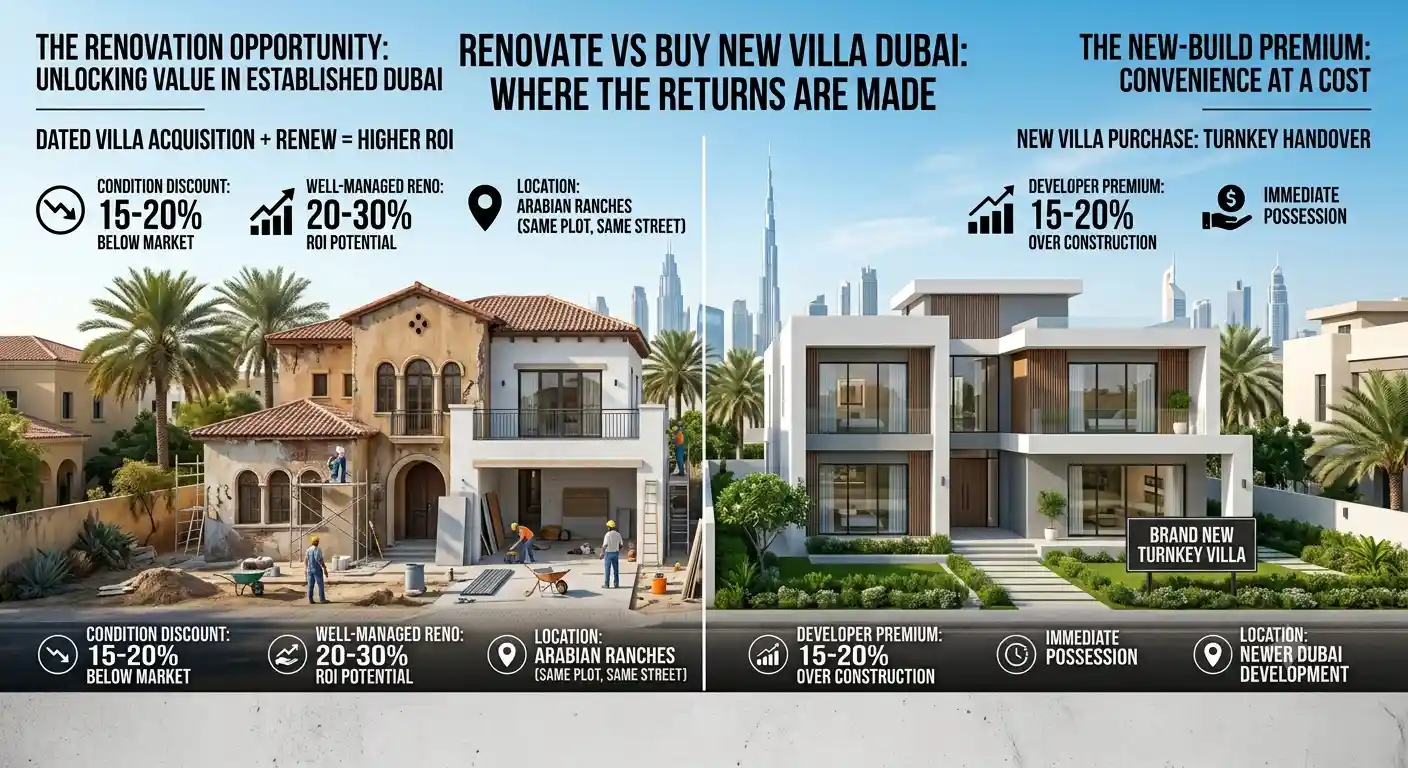
Renovate vs buy new villa Dubai is not a lifestyle decision — it is a spread calculation, and the spread almost always favors the dated villa in the right community. I have run this comparison across 15+ development and renovation projects, and the villas that deliver the strongest investor returns are rarely the newest ones on the street. They are the ones nobody else wanted to touch.
The New-Build Premium You Are Actually Paying For
A new-build villa in Dubai carries a developer premium built into the price — you are paying for the marketing campaign, the show villa, the sales commission structure, and the convenience of a turnkey handover, not just the construction cost. In my experience, that premium typically runs approximately 15-20% over what the same villa would cost to deliver through direct acquisition and renovation. That gap does not disappear once you move in. It sits on the balance sheet as capital you paid and cannot recover unless the entire market re-rates upward. A dated villa in the same community, by contrast, is priced against its current condition — not its potential — which is exactly where the opportunity sits.
The Value-Add Logic: You Are Buying the Discount, Not the Location
Every dated villa investment I have made rests on one principle: the discount comes from condition, never from location. A villa in District One or Arabian Ranches that looks tired on the inside is still sitting on the same plot, in the same school catchment, on the same street as the fully renovated villa two doors down. Across my transactions, the investors who get this wrong are the ones who assume a low asking price signals a location problem. Based on my experience, it almost never does — it signals an owner who has not maintained the property, or an estate sale where nobody wanted to deal with the renovation themselves. That gap between what the villa is worth today and what it is worth once brought up to the street standard is the entire investment thesis.
Renovate vs Buy New Villa Dubai: The Numbers Behind the Spread
Well-renovated villas in established Dubai communities command approximately a 12-18% resale premium over comparable unrenovated stock, and renovation ROI on these projects typically lands between 20-30% once the villa sells. Renovation cost itself ranges from approximately AED 80 per sqft for cosmetic upgrades — paint, flooring, fixtures — up to AED 700 or more per sqft for a full luxury rebuild touching structure and layout. On a 6,000 sqft villa purchased at a genuine condition discount, a mid-range renovation in the AED 150-250 per sqft band closes the gap to new-build standard at a fraction of what a comparable new villa costs to buy outright in the same community. The hold period on this model runs 8-14 months from acquisition to resale — short enough that the capital is not locked up waiting for a market cycle to bail out an overpaid new-build purchase.
Same Street, Same Plot, Different Price
I have walked comparables in Arabian Ranches and The Meadows where a dated villa and a recently renovated villa sat within three houses of each other, same plot size, same layout. The renovated one transacted at the top of the 12-18% premium band. The dated one sold below it — to whichever buyer was willing to do the work themselves. That difference is not a location premium. It is a condition discount waiting to be captured by whoever is willing to underwrite the renovation properly instead of walking away because the kitchen photos look dated online.
Where Buying New Actually Wins
I will not pretend the renovation model wins in every case. Buying new makes sense when there is no comparable dated stock to benchmark against — a newer, still-developing community with no resale history simply does not have a discount-to-potential gap to capture. It also makes sense for a buyer who values zero execution risk over return: no permits, no contractor management, no timeline uncertainty, just a handover key on a fixed date. That convenience is real, and it is exactly what the 15-20% premium is pricing in. The investor decision is whether that convenience is worth paying for, or whether you would rather manage the execution risk yourself and keep the spread.
The Execution Risk Nobody Prices Into the Comparison
The reason most buyers default to new is that a dated villa renovation carries real execution risk — permitting delays, contractor overruns, and the structural surprises that only show up once walls are opened. I underwrite a 10% contingency buffer into every renovation budget for exactly this reason, and actual overruns on my projects typically land at 3-7%, comfortably inside that buffer. A buyer without a network of vetted contractors and a scoped budget going in is the one who ends up paying new-build prices anyway, just later and with more stress. That is the actual risk being compared here — not renovation versus new construction, but disciplined execution versus none at all.
Frequently Asked Questions
1. Renovate vs buy new villa Dubai — which is the better investment?
Renovating a dated villa in an established community is typically the stronger investment when a genuine condition discount exists and the renovation is properly scoped and budgeted. Buying new makes more sense in communities without comparable resale stock, or for a buyer who values a turnkey handover over capturing the value-add spread.
2. How much does villa renovation cost per square foot in Dubai?
Villa renovation in Dubai ranges from approximately AED 80 per sqft for cosmetic upgrades such as paint, flooring, and fixtures, up to AED 700 or more per sqft for a full luxury rebuild that touches structure, layout, and MEP systems. Most value-add projects land in the middle of that range.
3. What resale premium do renovated villas get in Dubai?
Well-renovated villas in established communities command approximately a 12-18% resale premium over comparable unrenovated stock in the same community and plot size. This premium holds most consistently where there is genuine resale demand and comparable dated stock to benchmark against.
4. Is a dated villa a good investment in Dubai?
A dated villa is a strong investment when the discount reflects condition rather than location — same plot, same street, same community as fully renovated stock nearby. The investment thesis depends on accurately scoping renovation cost and timeline before purchase, not on the asking price alone.
5. How do I know if a villa is undervalued because of location or condition?
Compare the villa against at least three recently sold or renovated comparables on the same street or in the same sub-community. If the plot, layout, and location match but the price is lower, the discount is almost always condition-driven rather than a location problem.
6. What is the risk of buying a dated villa to renovate in Dubai?
The main risks are permitting delays, contractor cost overruns, and structural issues that only surface once renovation work begins. A properly underwritten project carries a contingency buffer of approximately 10% of budget, with actual overruns on well-managed projects typically landing at 3-7%.
7. Do new-build villas in Dubai cost more than renovated ones?
New-build villas typically carry a developer premium of approximately 15-20% over what the same villa would cost through direct acquisition and renovation, reflecting the marketing, sales structure, and turnkey convenience built into the new-build price.
If you are weighing a dated villa purchase against a new-build listing in the same community, that comparison needs real numbers before you decide — not a guess based on asking price. To have your specific comparison run against actual renovation cost and resale data, contact Saliq Zahoor directly.
WhatsApp +971 567 123 666 or email [email protected]. Visit www.eplogproperties.com for current listings and market data.
For weekly Dubai real estate analysis and on-the-ground market updates, follow @saliqzahoordxb on Instagram, TikTok, YouTube, and LinkedIn.