Undervalued Villa Dubai Investment | How to Spot One
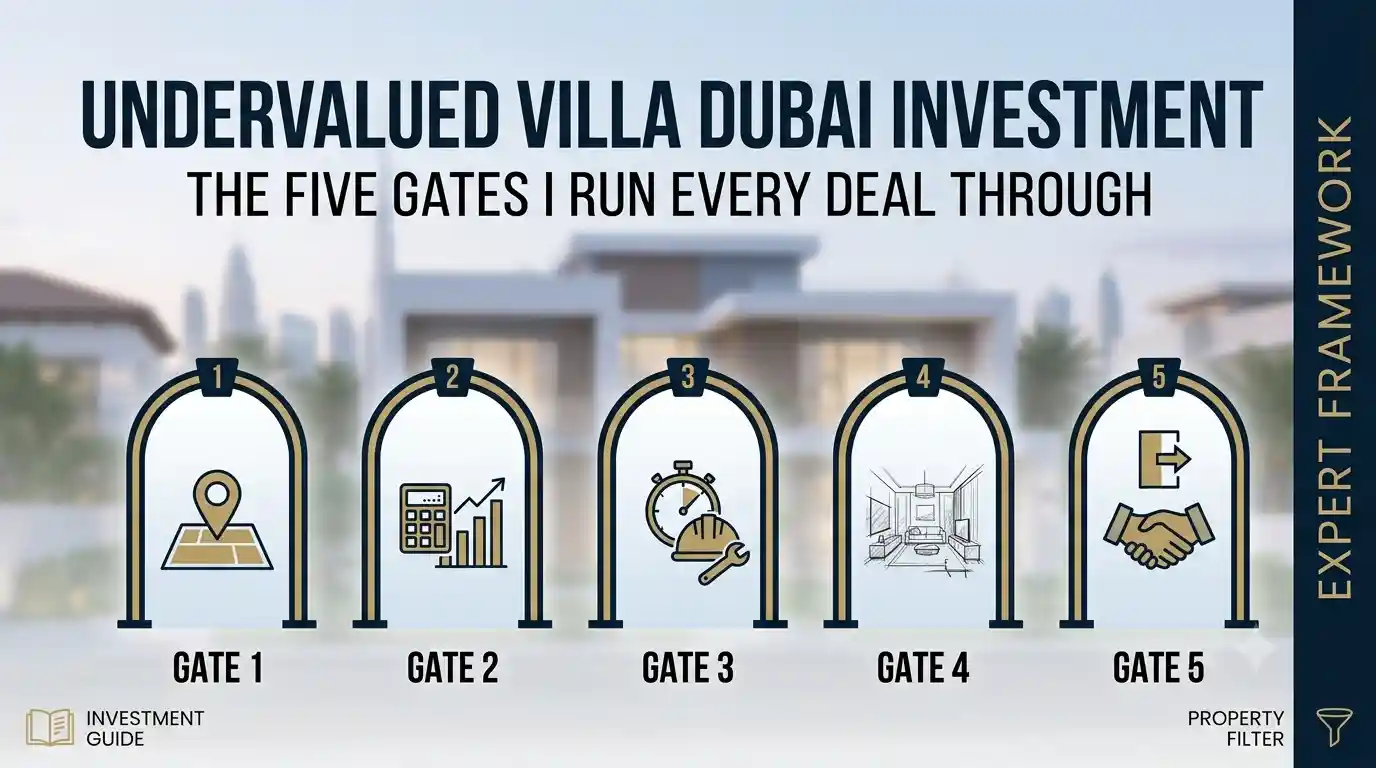
Undervalued Villa Dubai Investment: The Five Gates I Run Every Deal Through Before I'll Recommend It
An undervalued villa Dubai investment almost never shows up on Bayut or Property Finder with the discount still attached — by the time a genuinely underpriced villa reaches a public portal, the best buyers have already seen it and moved. I run every deal I bring an investor through a five-point filter before it earns a recommendation, and skipping any one of the five is how good-looking deals turn into bad outcomes.
Where an Undervalued Villa Dubai Investment Actually Comes From
Off-market villa deals in Dubai circulate through broker relationships before they circulate anywhere public. In my experience, an owner who needs a fast, discreet exit — relocation, a business need for liquidity, an estate sale — calls someone they already trust, not a portal listing agent they have never met. Across my transactions, the villas that delivered the strongest margin were sourced through a network of contractors, consultants, and past clients built over more than a decade in this market, not through scrolling listings. A serious buyer looking for this kind of opportunity needs to be inside that network before the villa is priced to move, not after.
Gate One: Location and Plot Quality
The first filter has nothing to do with the villa's condition. I look at the plot itself — size, orientation, position on the street, proximity to community amenities, and whether the surrounding stock in that sub-community actually transacts at a premium once renovated. A discount on a poorly positioned plot is not a discount, it is a fair price for a weaker asset. District One villas enter at approximately AED 8M with a strong yield profile, Arabian Ranches sits in a similar entry band, and Emirates Hills opens at approximately AED 20-35M with the lowest yield of the three but the highest exclusivity — the plot and community data matter as much as the asking price. A villa priced low in District One, Arabian Ranches, or Jumeirah Islands, on a plot that matches the best comparables on the street, is a completely different proposition than the same discount on a plot backing onto a service road.
Gate Two: Feasibility and the Return Model
Once the plot clears gate one, I run the numbers on what the villa needs and what it will return. This means comparing the acquisition price plus renovation cost against realistic resale value based on actual recent comparables — never optimistic projections. Renovation ROI in this segment typically runs 20-30% once a project sells, built on a resale premium of approximately 12-18% over comparable unrenovated stock. If the feasibility math does not clear that range with room for error, the deal does not pass gate two, regardless of how good the story sounds.
Gate Three: Cost Control Before Capital Moves
An undervalued villa can still lose an investor money if renovation cost runs away mid-project. I underwrite every deal with a full scope of work before purchase — structural condition, MEP systems, permitting requirements — plus a 10% contingency buffer on top of the budget. Based on my experience, actual overruns on properly scoped projects land at 3-7%, comfortably inside that buffer. A deal that looks undervalued on paper but has not been scoped for hidden cost is a liability wearing a discount.
Gate Four: Design and Exit Value
The renovation has to be designed for the buyer who will eventually purchase it, not for the investor's personal taste. I have seen investors spend heavily on rooms a resale buyer barely evaluates — a formal dining room, a rarely used study — while underspending on the kitchen and master suite that actually drive the offer. Kitchen and master bathroom work consistently delivers the strongest return per dirham spent, with outdoor space and pool areas close behind in communities with genuine outdoor living culture. Gate four checks that the design plan matches what moves resale value in that specific community, before a single wall comes down.
Gate Five: Exit Liquidity
The final gate asks a simple question: who is actually going to buy this villa once it is renovated, and how quickly. A villa in a community with genuine resale demand and comparable renovated transactions clears this gate easily. A villa in a thinly traded pocket with no resale history is a harder underwrite, no matter how attractive the acquisition price looks, because exit liquidity determines whether the 8-14 month hold period actually holds.
Frequently Asked Questions
1. How do I find an undervalued villa Dubai investment before it goes public?
The most reliable opportunities come through broker relationships and off-market networks built on trust with sellers, not through public portals. By the time a distressed or motivated-seller villa reaches Bayut or Property Finder, the strongest discount has usually already been negotiated away.
2. What makes a villa a genuinely undervalued investment in Dubai?
A genuinely undervalued villa has a discount driven by condition or seller urgency, not by a weaker plot or location. It clears a full feasibility check against real comparables, has a scoped renovation budget with contingency built in, and sits in a community with proven resale liquidity.
3. What is the Five Gates framework for evaluating a Dubai villa deal?
The Five Gates are Location and Plot Quality, Feasibility and Return Model, Cost Control, Design and Exit Value, and Exit Liquidity. Every deal has to clear all five before it is recommended to an investor — a strong result on one gate does not offset a failure on another.
4. How do off-market villa deals in Dubai actually work?
Off-market villa deals circulate through established broker networks and past-client relationships before they are advertised publicly. Sellers needing a fast or discreet exit typically approach someone they already trust rather than listing on a public portal, which is why access depends on being inside that network.
5. How do I find distressed property in Dubai without overpaying?
Finding distressed property without overpaying requires comparing the asking price against at least three recent comparable transactions in the same sub-community, not against the seller's own asking narrative. A distressed price only holds up as a genuine opportunity once renovation cost and realistic resale value are both factored in.
6. What renovation ROI can investors expect on an undervalued Dubai villa?
Renovation ROI on a properly sourced and underwritten villa typically runs 20-30% once the project sells, built on a resale premium of approximately 12-18% over comparable unrenovated stock in the same community. This range depends on accurate feasibility work at acquisition, not on the discount alone.
7. Why do some undervalued-looking villas turn out to be bad investments?
A villa can look undervalued on price alone while failing on plot quality, renovation cost exposure, design misalignment with resale buyers, or thin exit liquidity in that community. Any one of these factors can erase the apparent discount, which is why a full five-point screen matters more than the headline price.
I apply this five-gate filter to every deal before I bring it to an investor — if you want your next villa opportunity run through the same process before you commit capital, that conversation starts with a direct message. Contact Saliq Zahoor directly.
WhatsApp +971 567 123 666 or email [email protected]. Visit www.eplogproperties.com for current listings and market data.
For weekly Dubai real estate analysis and on-the-ground market updates, follow @saliqzahoordxb on Instagram, TikTok, YouTube, and LinkedIn.